Beam me up Scotty!

Maybe they were Star Trek fans… that would make more sense.

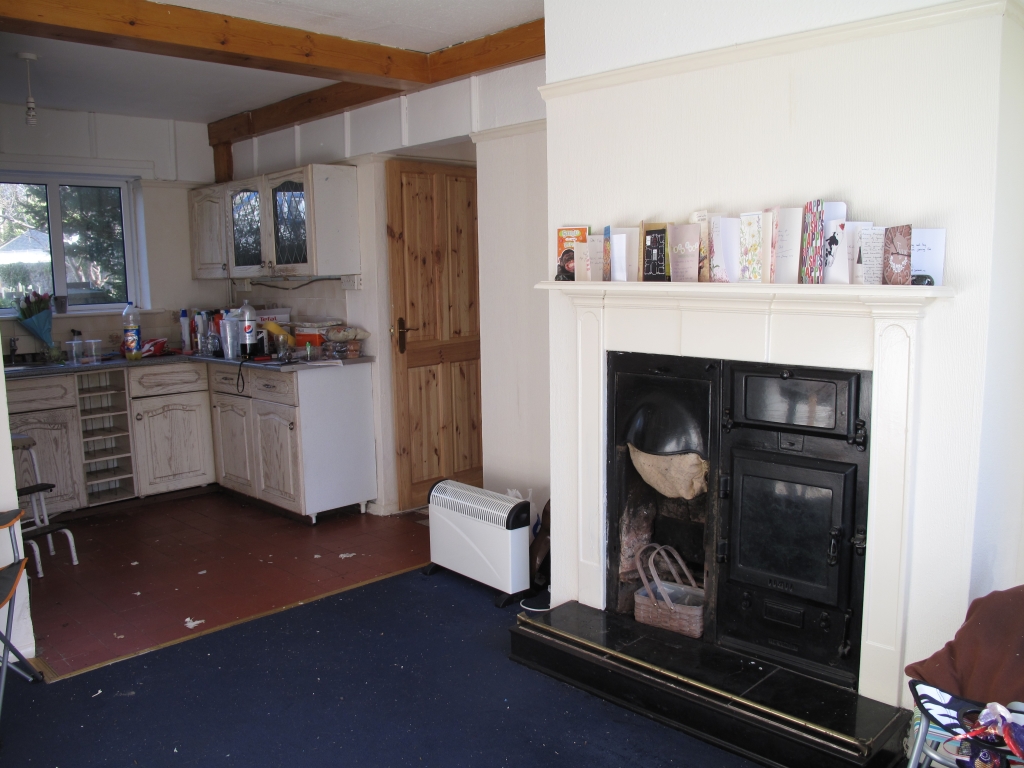
Because I want to make the extension at least partly open plan I’ve been trying to identify which walls are structural and which aren’t (all the walls in the house – loadbearing or not are brick).

You can see in this floorplan that there is a half wall in the kitchen:

Original Floorplan Downstairs

That half wall is cavity wall thickness and was connected to a boxed in area which I feared was surrounding a load bearing beam.  Next door don’t have a ‘half wall’ but I did notice they did also have a beam – so it didn’t look promising.  You can see the pine clad beam in this photo:

Beam in Situ

I wondered if there had once been a wall there to separate the room into two – but that wall would have ended up in the middle of the doorway (see the floorplan), perhaps the door had also moved but, as I’ve said before, the weird skirting board is everywhere so it seems very unlikely the layout has ever changed.

So on the way home from work one night I decided to try to determine, once and for all, if that boxed in area was hiding a load supporting beam or not. Unfortunately, being weak, feeble and 5ft 1 – my lack of purchase while teetering on a padded stool in my work shoes wasn’t the best so I only managed to prise the boxing open by about an inch.

Beam wedged open

I slide my phone in and took a photo. And the conclusion?

inside of beam

I was expecting pipes or wires at the very least but no, it’s completely empty!!!! The only thing of note was that the ceiling was painted blue at the time the beam boxing was installed. So it’s definitely not load bearing then! Hurrah. But why on earth would someone install a fake beam?

Anyway Matti came by and I asked him to pull it down.  Here he is showing it who’s boss! (Life must be so much easier when you’re not titch)

matti beam

and the beam was no more:

Beam no more

Well, except for the other beam but that one is definitely hiding pipes.

Chim, chimney, chim, chim, cher-ee

The house has two fireplaces – one in the living room and one in the dining room so they are back to back and share a single chimney stack.  There must have been one in the master bedroom too but that’s been blocked up and plastered over.

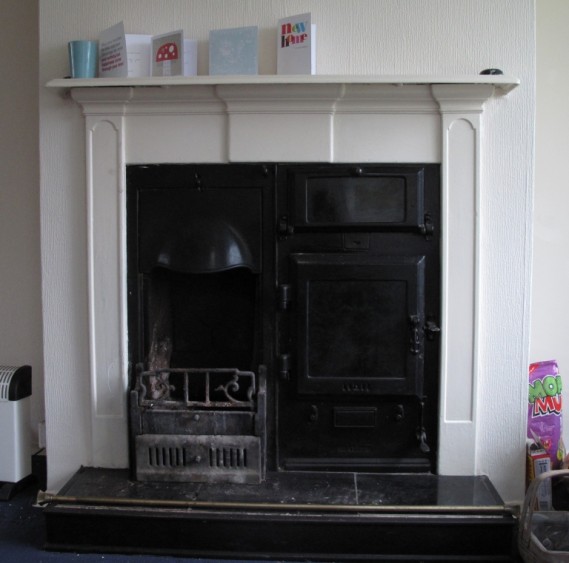
The one in the dining room is this range type thing – which fascinates me as it looks much older than the house. Note the cushion (complete with tassel) used as a chimney balloon.
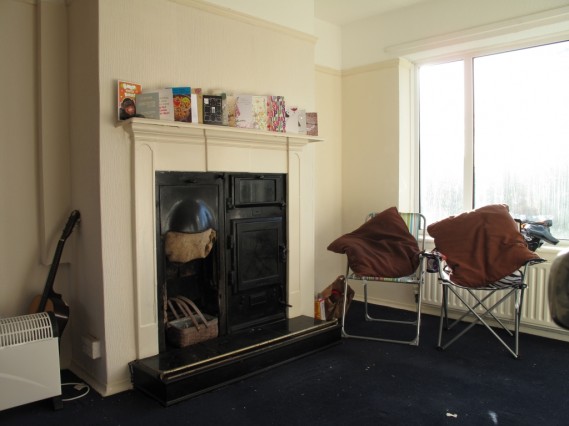
fireplace

The one in the living room was boarded up and there wasn’t any obvious way into it.  I think the electric fire currently by the outbuildings had previously been mounted on the front of it. It looked like this:
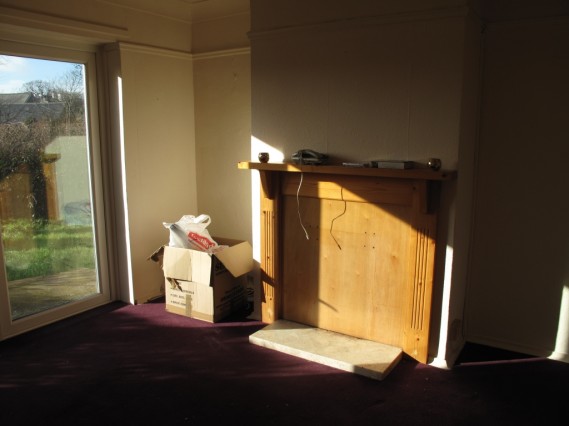
Fireplace boarded up

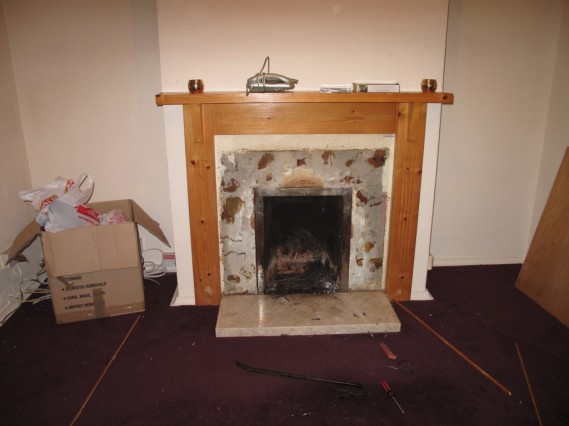
I eventually took one of Dad’s crow bars (which was a completely inappropriate tool) to find out what I had – from knocking at it, I was aware there was some sort of opening behind – the mantle was obviously fairly new (it was wallpapered behind!) but who knows there still might be something beautiful underneath the panelling.  So with a lot of huffing and puffing and bashing I got the panel off. Was there something beautiful? Erm, no – there was this:
Opened up fireplace

Pretty.  Note the twigs?  Hmm, looks like a bird’s nest too.

What to do with the fires has been one of my big uncertainties – prior to getting the house I’d convinced myself they were going to have to go as they took up too much space in the rooms – next door have had their whole chimney stack removed. When I actually got the keys I discovered the rooms were actually bigger than I’d remembered (although they are still not massive) and the difficulty (the chimney breast supports the purlin in the roof) and cost to remove vs the space that would be gained probably means they are staying.

The range was particularly troublesome because although it’s a lovely feature, if I was going to have something so big, taking up so much space – I’d quite like it to be usable.

So I decided to get the chimneys swept and to see if that got me any further to making a decision.  Thursday lunchtime I went down to meet the chimney sweep – who I was surprised to discover was about my age, for some reason I’d expected him to be at least 100. His jaw actually dropped when he saw the range (the company is two brothers and although I’d explained all to the other one I don’t think he’d passed the info on) but he cracked on nevertheless and promptly came across a huge bird’s nest.  I’d assumed the chimney must have been in use relatively recently as the coal bunker is still right outside the back door but he reckoned it couldn’t have been swept for at least a decade.  The birds had been nesting in it for so long the twigs had composted and bin bags of soil were coming down.  It took ages!  After he got the chimney swept he started investigating the range for me to discover how it works (I couldn’t get my head around how the food in the oven could be heated uniformly with a fire on one side) – I think I’ll save all that for another post though (it needs photos to explain properly).  The chimney has really good draw though and he lit a ball of paper and it burnt really well – also no masonry or anything came down while he was sweeping it so it’s basically good to go (except it’s not – more about that later too).

The other fireplace also had a birds nest but not quite as solid as the first so was much quicker to sweep.  He didn’t light that one as there was quite a bit of down draft.  He recommended I get some bird cowls ‘before the Spring’ to stop the birds coming back – so I should probably get on that sharpish.

Chim chiminey
Chim chiminey
Chim chim cher-oo!
Good luck will rub off when
I shake ‘ands with you

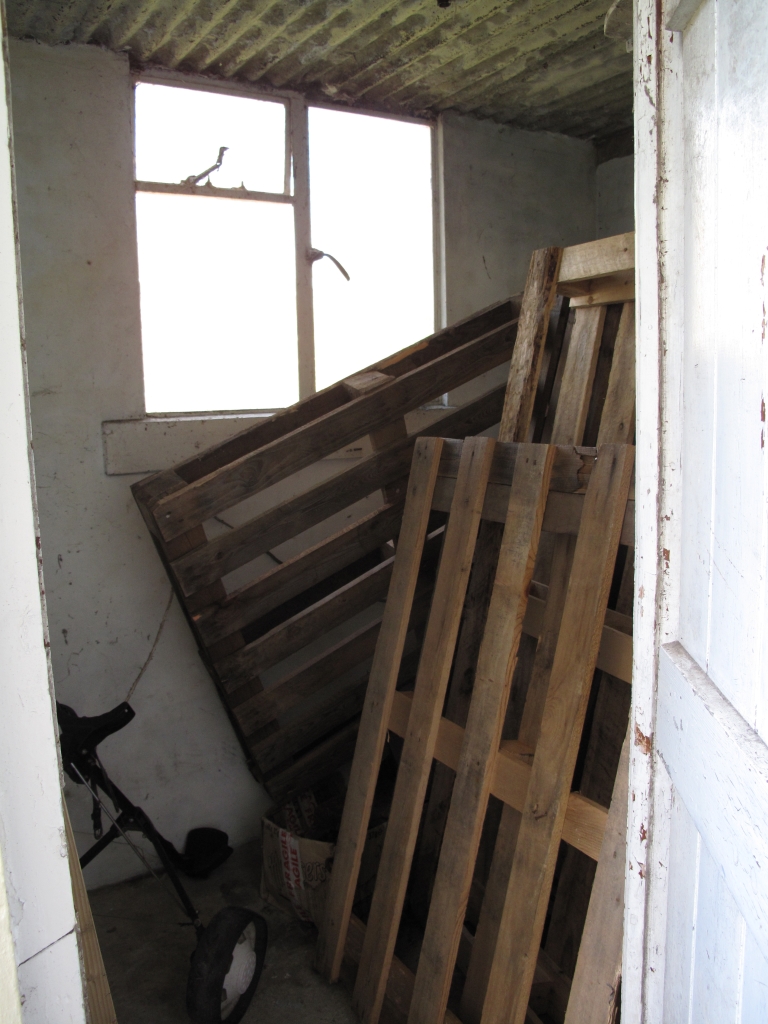
I know chimney sweeps are meant to be lucky but I did have the oddest stroke of luck while the sweep was sweeping.  I decided it was probably best not to sit watching him and asking inane questions (don’t get me wrong, I did that for a while) so potted around the house doing odd jobs and hoovering – then I went to sort out the pallets in the outhouse.  There’s no light in the outhouse and as the days are short at the moment and the weather has been awful, I’d not been in there properly other than to stuff the pallets in – there were a few old boxes but I didn’t think there was anything in them.  You can see a box in this photo:

pallets

In fact, that very box turned out to be full of rusty old bits of cast iron.  It was clearly bits from a fire but, to me, most just seemed random and disconnected.  Anyway, I pulled them all out and was brushing them down when the chimney sweep came to find me and immediately identified what they all were.  All the parts of the open fire in the living room were there – in all their retro glory.  So that it now looks like this:

Fire with grate

Also there was the fret from the front of the range (which obviously needs some polishing) plus the frame for the damper 🙂
range with fret

Lucky, huh?  I’m not sure I would have realised that fret (I’m calling it a fret as I’ve no other word for it) was something that was intended to go on the front of the range if the chimney sweep hadn’t have been here when I made the discovery!

Then I hot-tailed it back to work after a 3 hour lunchbreak.  Whoops…

It’s getting hot in here

Except it’s not.

As the tenants only left last summer so I figured the heating would probably work.  That might have been a bit optimistic given… erm, this:

Old Old Boiler

So, one of the first things I did once the electricity was on was to try to fire the boiler.  I’ve never actually had to fire a boiler before (they’ve always just already been on) so I clicked what I assumed was the ignition a few times – it did nothing.  Then I turned that green handle about half way up the right hand side.  It made a whooshing sound – I clicked the ignition a few more times – still nothing.  I stood back and pondered.  Then something seemed to burst and heating oil started spurting up the wall, hitting the roof and raining down on my head.  I jumped forward and turned the green handle again and it stopped.  I shut the door and asked my friends to wrap up warm and bring around some electric heaters.  After a couple of weeks of doing my best to ignore it, I gave me old primary school chum Ste (who’s now a plumber) a text and he came round and gave me some sage advice.  

So firstly, Ste points out that you’re not meant to turn that handle and, had known where to look, I’d probably have seen the pressure gauge steadily rising before it “blew” (which was actually just the overflow kicking in).  Then he asked me where the controller was to switch the boiler on  – “erm, you mean this thermostat thing on the wall in the kitchen?” – he flicked some switches and the pump started up.  Unfortunately it didn’t fire so it’s probably “a part”, he volunteered to send his service guy around but I don’t think it’s worth it – I’m going to have to get a new boiler anyway but that leads us on to the next problem – where to put it?

The boiler is currently in one of the outbuildings which will be demolished for the new extension – so the boiler has to go in the new extension, in part of the existing house or outside (it has to be a special outside boiler in that case).

I gave Ste a decent grilling about what’s the best approach with regard to boilers and heating systems in general and my house specifically – this is what I learned (well, some of this I knew before but is included for completeness):

  • Regular boilers have a separate hot water cylinder (this is the system the house currently has)
  • Combi boilers don’t have a separate hot water cylinder (they heat the water on demand)
  • The current hot water cylinder will need to be replaced and the cupboard it is contained within is too small for a modern cylinder
  • There is quite a bit of space under the floorboards on the ground floor (enough to get down and run pipes)
  • A boiler has to have a flue to an outside wall (it couldn’t go in the coat closet)
  • The cylinder doesn’t have to be against an outside wall although it will need to be vented to the outside, this could be under the floor (it could go in the coat closet)
  • An outside boiler is no less efficient than an inside one.
  • A combi or a cylinder should be as close as possible to the taps which use hot water.
  • It doesn’t matter how far away a regular boiler is from the taps.
  • You can’t chase pipes into brick walls so they will need to be boxed in, somewhere they can all be grouped together will mean a neater job can be made.
  • The cost to supply a combi vs a regular boiler plus a cylinder is about the same.
  • It is about an additional day’s labour to install a cylinder
  • For a my sized house with one bathroom, a combi would be fine
  • For a my sized house with one bathroom and an additional shower room (which is unlikely to be used at the same time) a combi should be ok
  • For a my sized house with two bathrooms (or the prospect of later putting in another bathroom) a regular boiler plus a cylinder would be best, a combi wouldn’t cut it.
  • The hot water cylinder could go in the loft but the floor would need extra support.
  • The cold water storage tank in the loft would be removed
  • The soil pipe is cast iron so another toilet couldn’t be added to the stack
  • There is a manhole outside the front door so it might be possible to run a new soil pipe
  • New radiators are more efficient than the old ones and for the cost, it’s probably a worthwhile upgrade
  • The radiator in the living room (which annoyingly takes up the only wall without a door or a fireplace) could be switched for a vertical one next to the French doors)
  • The radiator in the hall could be changed for a smaller one
  • The radiator in the bathroom has a dodgy bit of pipe (“could go at any time”)
  • He likes my plan to reconfigure the bathroom and add a shower
  • I don’t have to redo all the piping (particularly the bedrooms) but it might be a good idea to do it all at once.
  • My pressure is too high – it needs reducing (high pressure is hard on taps etc)
  • He showed me where the oil level was in the oil tank
  • It’s a single skin oil tank
  • I’ve a lead supply pipe
  • Oh, he showed me how to take the radiators off the walls

I also got him to give me a load of finger in the air prices but until I decide exactly what system I’m going to get and where it is all going to go, we can’t really make an progress.

N.B. all of the above relates to oil boilers – I’ve no idea about gas as oil is cheaper on the Isle of Man.